The fifth in a year-long series on artists who are making the topic of water a focus of their work and on the growing number of exhibitions, performances and publications that are popping up in museums, galleries and public spaces around the world with water as a theme.
______________________________
Unlike many contemporary artists who have come only lately to incorporating the theme of water in their work, American artist Roni Horn has been exploring the nature of water for over 30 years. In her drawings, photographs, installations, writing and books, she has posed questions that challenge us to examine our own personal relationship with water as well as its universal qualities. In a 2005 interview by Art 21 on her works Doubts by Water, Same Thames and Still Water, Horn admits: “I never intended to have water in everything I do, but I almost feel like I rediscover it again and again. It just finds its way back into new work.”
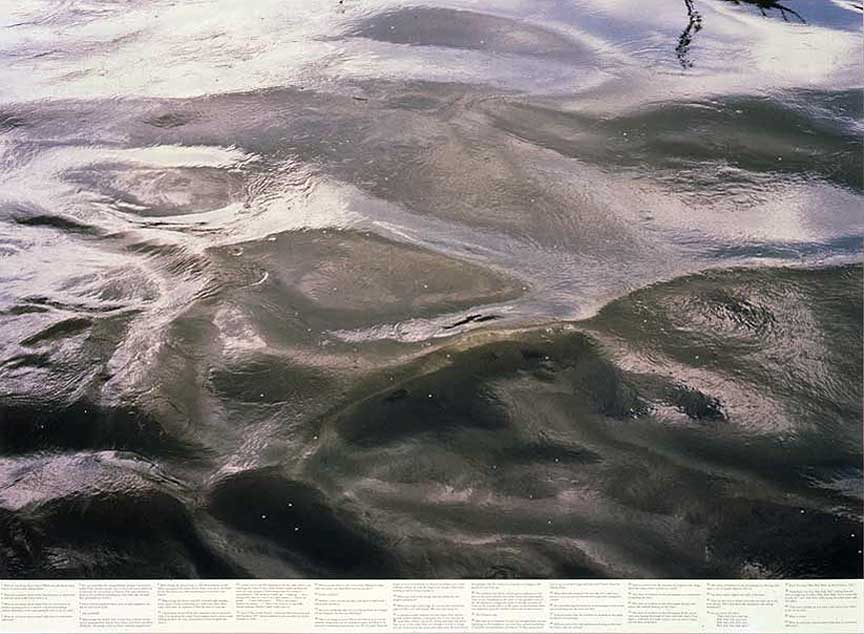
Still Water (The River Thames, for Example) – Image C, 1999. Offset lithograph (photograph and text combined) on uncoated paper; 30 1/2 × 41 1/2 inches. Edition of 7. Courtesy of Matthew Marks Gallery, New York.
Since Horn is such a prolific artist and doing justice to all of her work (which in addition to water, explores human identity, ecology, landscape, weather and language) would require no less than a book (several do exist), I’ll focus here on two of her pieces that represent her attempt to define water’s elusive nature: (1) Saying Water, a 40-minute monologue that she created about the Thames River in London; and (2) Vatnasafn / Library of Water, a project in Stykkisholmur, Iceland in which she restored a town library building as a public space housing her own installations and a place for community gatherings and programs.
Saying Water
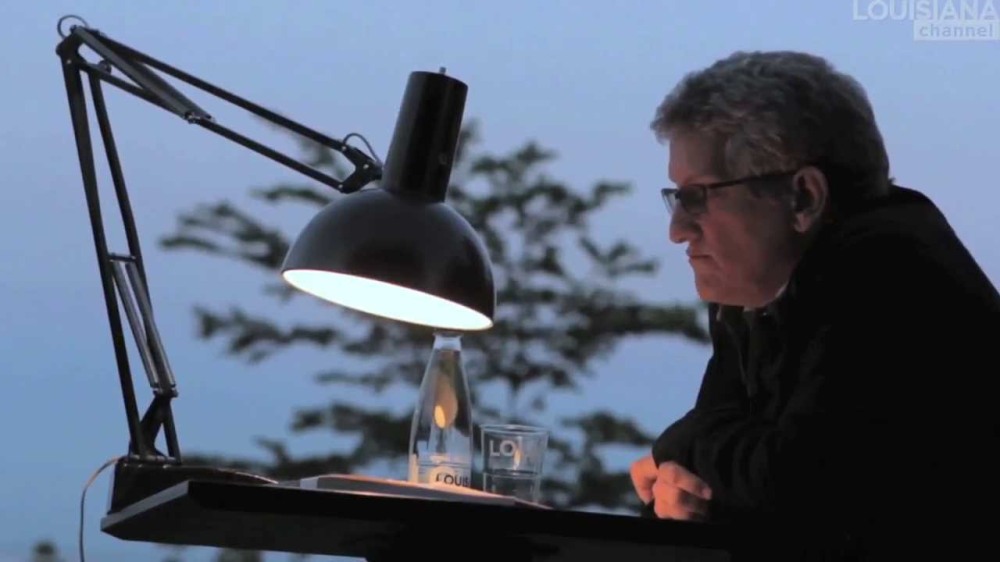
Horn wrote Saying Water in 2012 while she was staying in A Room for London, a riverboat installation sitting on the roof of Queen Elizabeth Hall overlooking the South Bank of the river Thames. Her residency was part of a larger project entitled Hearts of Darkness, in which artists and “stowaways” from other professions were invited to create something new related to the river and the project’s theme.
Roni Horn reading Saying Water at the Louisiana Museum of Art, Denmark in May 2012. Courtesy of Louisiana Channel.
As she reflects on the meaning of the dark, opaque and dirty Thames river, Horn incorporates song lyrics (“Blah, Blah, Blah” by George Gershwin; “Down by the River” by Neil Young; “Take Me to the River” by Al Green; etc.) and stories of suicide, sex and murder that occurred in or by the river. She poses numerous questions: “When you talk of the water, are you talking of yourself or the weather?” “Is water sexy?” “What does water look like?” “Do rivers really ever end?” But primarily, she is developing a comprehensive and powerful vocabulary about water itself and its physical, sensual, spiritual and fundamentally unknown qualities. Here is just a small sampling of her powerful visual language:
Water is… everywhere differently, a spiritual presence, an intimate experience, half the sky, an act of perpetual motion, familiar but elusive, troubled or calm, rough and disturbed, quiet, clear, still, cold or hot, brash or brisk, soft or hard, foul or fresh, limpid or languid, sweet, agitated, unsettled, deep, clean or filthy, a utopian substance, powerful, vulnerable, fragile, energetic, the future, a plural form, a master verb.
Water… reassures you, affirms you, shows you who you are, extends you out into the world, camouflages light, sighs, sucks, laughs, splishes, splashes, slashes, washes, murmurs, gushes, bubbles, babbles, shimmers, shines, gleams, twinkles, sparkles, blinks, winks, waves.
Black water… is always violent; it dominates; it’s alluring; it’s black milk; it’s life threatening; it’s mesmerizing.
Horn acknowledges the level of pollution in the Thames by imagining what the water contains: “not just the rats and sewage but the viruses and bacteria like hepatitis, dysentery, E. coli, biles and even a remnant of the plague… the polyphenols… the trichloral ethanes…” And at the end of the monologue, she proclaims that “when you look at water, you see what you think is your reflection but it’s not yours; YOU are a reflection of water.” Immerse yourself in Horn’s Saying Waterhere. Although listening once is great, twice or three times is better in order to absorb the full impact of her cadence and imagery.
Vatnasafn / Library of Water
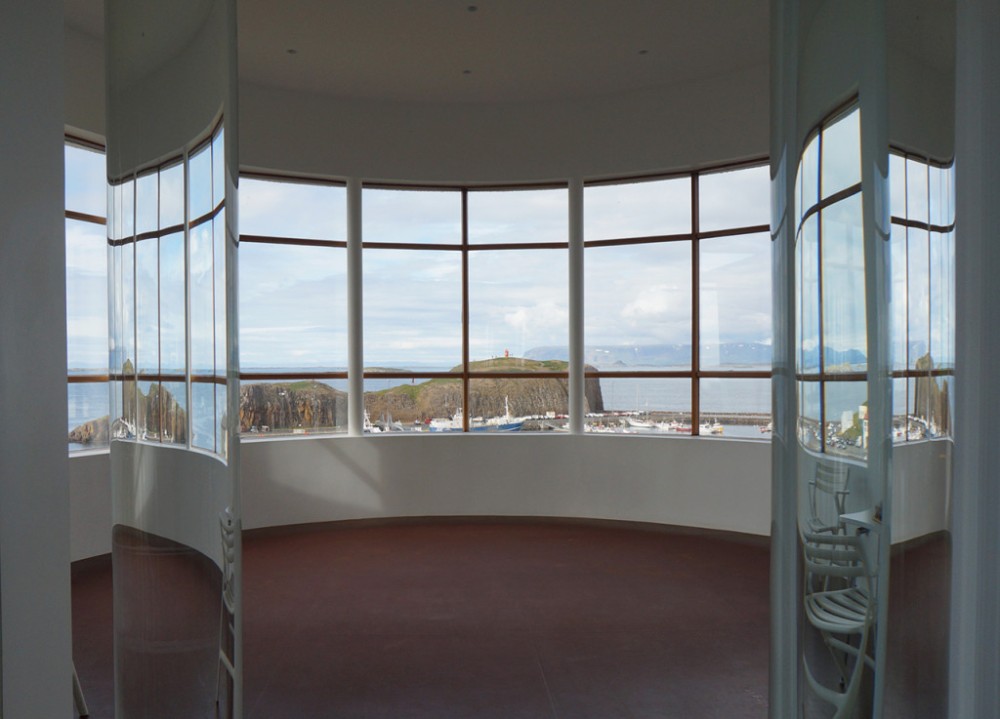
Horn has a strong emotional tie to Iceland. Her first journey there was right after graduate school, when she traveled throughout the country by motorcycle. Since then she has returned again and again, ultimately establishing a residence in Iceland where she resides for part of the year, and incorporating its pristine landscape, changing weather, intense light and distinct geography as a major component of her work. In 2003, she began a long-term project to create a new identity and purpose for an existing library in the small town of Stykkisholmur, Iceland. Horn called it “the most beautifully situated library in the world,” overlooking the harbor and offering astounding views of the ocean and an overwhelming sense of sky, sea and weather.
View of the water from Vatnasafn / Dictionary of Water, Stykkisholmur, Iceland.
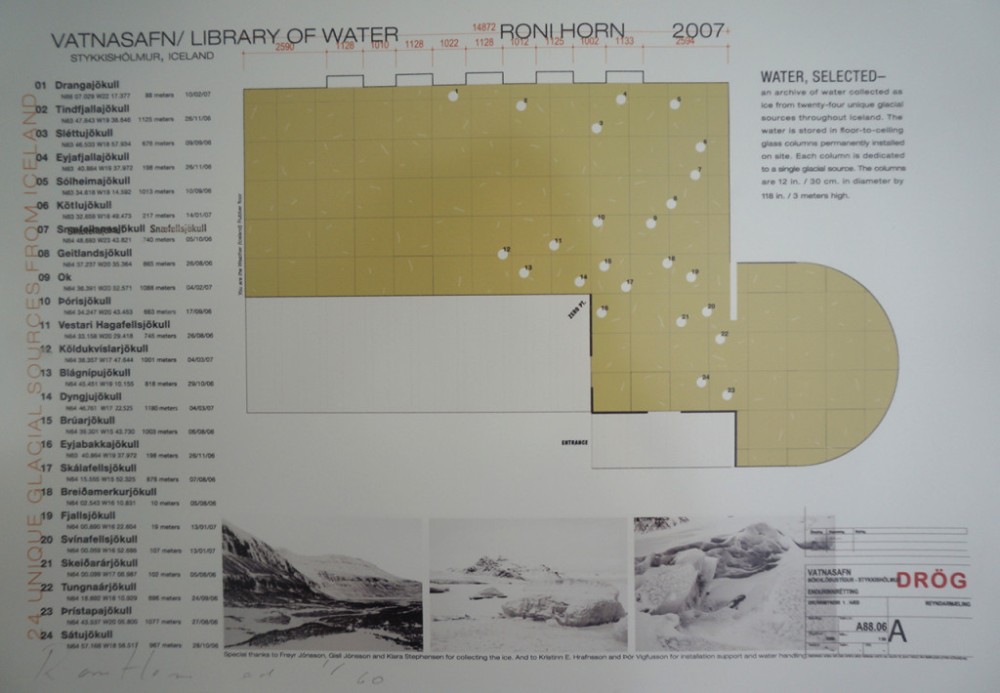
Completed in 2007, the Library of Water contains three works by Horn: The first is a “bilingual sculpture installation,” a rubberized floor containing 100 inscribed words in Icelandic and English that refer to the weather, an integral part of life in Iceland. The second is a series of 24 floor-to-ceiling transparent columns filled with water from 24 of the major glaciers in Iceland that were formed millions of years ago and are receding at a rapid pace. The columns refract and reflect the light from the vast landscape outdoors, and create a sense of tranquility and peace within the interior space. The third work is a collection of stories on weather, a project that Horn undertook to record the memories of, and reflections on, weather from residents of the area in an attempt to capture its significance in their lives.
Documentation of the location of the sources of water and placement of columns for Installation of columns containing water from 24 glaciers in Iceland, Vatnasafn Dictionary of Water, Stykkisholmur, Iceland.
Horn has written, spoken and created hundreds of works of art about water of all kinds. In contemplating the dirty Thames, she marveled that
…even in its darkness, it has this picturesque element. It’s something about the human condition – not the water itself – humanity’s relationship to water. So, in the end, it doesn’t make a difference what the water looks like. It will always have this kind of picturesque quality to it because that’s almost a human need – that water be a positive force.
(Top image: Installation of columns containing water from 24 glaciers in Iceland, Vatnasafn Dictionary of Water, Stykkisholmur, Iceland.)
_____________________________
Susan Hoffman Fishman is a painter, public artist, writer, and educator whose work has been exhibited in numerous museums and galleries throughout the U.S. Susan’s latest bodies of work focus on the threat of rising tides caused by climate change, the trillions of pieces of plastic in our oceans and the wars that are predicted to occur in the future over access to clean water. Susan is also the co-creator of two interactive public art projects: The Wave, which addresses our mutual need for and interdependence on water and Home, which calls attention to homelessness and the lack of affordable housing in our cities and towns.
Anna Ladd’s “Bee Spit” is created from sterling silver, copper and gold.
Humboldt State University’s Third Street Gallery in Eureka will present “HOT,” an exhibit that addresses climate change and global warming, starting Monday and running through March 4 in the gallery’s South Room.
This exhibit — which features the work of 17 student and alumni artists from HSU —explores ideas about climate change — its causes and effects. The artists are addressing issues of rising temperatures, pollution, natural disasters, rising sea levels and diminishing resources. Participating artists are showing work in sculpture, ceramics, photography, painting, prints, jewelry and mixed media.
Alumna Elisa Griego-Martinez, for example, uses gouache and ink suspended in acrylic over maps and hydrographs to illustrate her thoughts about the recent wildfires.
“Amplified by climate change, the recent dry spell has lingered on despite record rainfall, causing low agricultural yields, wildfires and stress on available resources,” Griego-Martinez said. “It has not only changed the landscape, but the political and social climate of the region.”
This exhibition will run in the gallery’s South Room along side local artist Cynthia Hooper’s solo exhibition, “Cultivated Ecologies,” an interdisciplinary video and essay project that examines California wildlife refuges.
Artists participating in “HOT” include Regina Case, Julie Clark, Tim Clewell, Gio King, Haley Davis, Lizzy Dostal, Claire Esselstrom, Lisa Griego-Martinez, Chelsee Harris, Harley Hinkle, David Jordan, Anna Kowalczyk, Anna Ladd, Malia Matsumoto, Bethany Matthis-Montgomery, Terry Torgerson and David White.
The gallery — located at 416 Third St. in Eureka — is open Tuesday through Sunday, noon to 5 p.m. A public reception for the artists is slated for Feb. 3 from 6 to 9 p.m., during Eureka Main Street’s Arts Alive! program. Groups are encouraged to call ahead to arrange tours. For more information, call 707-443-6363 or visit www.humboldt.edu/third.
When I tell people I’m an eco-musician, they give one of two responses: knowing appreciation or a puzzled furrow proceeding something like, “What do you mean by eco?”
I explain that this unique diction was not my doing. L.A. Talk Radio’s Diana Dehm realized the importance of music in carrying the torch of progress and claimed the term long before I’d heard it. When I met her over the Internet waves, she was looking for musicians that were writing about the state of our environment for her sustainability news show. Once she began to routinely broadcast the title track from my 2016 album Let’s Talk About the Weather, I knew that I had earned my entrance to the eco-musician’s club.
But how, do you ask, does one become an eco or ecological musician? In my case, the musician I’ve always been was wooed and captured by ecology – its majesty and its tragedy.
I was first moved by what humanity was doing to itself while working on a recording project on the glorious island of Maui in 2012. I carpooled to work with a local lawyer who suffered greatly from lung problems, whose children regularly stayed home from school due to respiratory illness. She was lobbying in the capital against irresponsible sugar cane waste burning practices, which coupled with volcanic emissions to produce a thick haze many simply could not endure. Citizens regularly called in sick, missed school, and suffered without protection. Her and other citizens’ efforts were being disregarded by both industry and the state.
The day I – an athletic, healthy 26 year-old – developed a lung infection from the industry smoke, I was moved to sit at the piano. Despair rolled over me as I contemplated for the first time whether human beings deserved this exquisite planet, or if she would ultimately facilitate our self-destruction. I determined that if there were enough people willing to earn our keep here on Earth – to devote their lives to change – I was willing to dedicate my life to fixing the broken systems enabling these kinds of injustices. I knew my quest would fail if a critical mass of others didn’t join in. So while I chose to pursue a purposeful, challenging passion, I simultaneously promised myself that I would do everything in my power to inspire others to do the same. Then I wrote a song about it.
Four years later I released my first album, a work that spoke directly to drought, immigration, economic struggle, climate change, protest, PTSD and reaching for distant dreams. Less directly, it expressed the pain of my history with a drug addictand genocide I had experienced in the depths of sleep. It drew from my frustrations with the status quo, nationalism, corporate life, and sexism, and ultimately served to push me into the world with a sense of worth as an artist that I had never imagined.
I worried about being wrong in the eyes of certain audiences, but was welcomed into circles that understood my pain and drive – universities, environmental organizations, and eventually Climate Science Alliance reached out to partner. To be sure I was doing everything I could to examine our most challenging problems and promising solutions, I accepted a year-long scholarship to grad school in International Environmental Policy at UCSD. I am currently examining the central theme of my newest performance work, The Let’s Talk About the Weather Experience (LTAWE).
The musical performance takes a burning question I had when I was 17 – “How is capitalism’s growth imperative sustainable?” – and rolls it into the personal experiences that have shaped my activism in the field. From planning rallies, to living in a tiny house on a farm, to declaring bankruptcy against one of the banks funding DAPL, my experience is a testament to my vigorous defense of the commitment I made to myself that smoky day in Hawaii.
The LTAWE makes an extra effort to paint a promising future for humanity. Paul Hawken’s book Drawdown is an inspiration for infusing the highest priority tools and solutions to climate change into the work. In order for people to interact with these and other ideas presented, the performance is followed by an opportunity to live up to its name: an interactive discussion on policy solutions to climate change, pollution, poverty, and corporate responsibility concludes the show.
What people often don’t realize about ecology is that it encompasses both relationships between humans and humanity’s relationship to our environment. Not only are our sociopolitical systems failing to act quickly and protect the world’s people, but they are failing to protect the very ecosystems that make life possible. It is my personal intention to intervene as artfully as possible. I hope that you are inspired to join us.
______________________________
Ashley Mazanec is an eco musician and founding director of EcoArts Foundation. A partner and affiliated artist at the Climate Science Alliance, her creative work in eco-entertainment has brought her to speak and perform for festivals, universities, grassroots organizations, nonprofits, and corporations. The podcast named after her 2016 album Let’s Talk About the Weather showcases the shining stars of the ecological art movement. Ashley’s work can be heard on LA Talk Radio and in corporate stores such as T.J. Maxx, Hershey’s and Abercrombie Kids. You can catch her live solo and with her progressive rock band Ashley and The Altruists, hosting eco art events, and supporting causes with groups such as such as Surfrider, The San Diego Green Building Council, and International Rescue Committee.






.jpg?mode=max?w=780)


