The fifth in a year-long series on artists who are making the topic of water a focus of their work and on the growing number of exhibitions, performances and publications that are popping up in museums, galleries and public spaces around the world with water as a theme.
______________________________
Unlike many contemporary artists who have come only lately to incorporating the theme of water in their work, American artist Roni Horn has been exploring the nature of water for over 30 years. In her drawings, photographs, installations, writing and books, she has posed questions that challenge us to examine our own personal relationship with water as well as its universal qualities. In a 2005 interview by Art 21 on her works Doubts by Water, Same Thames and Still Water, Horn admits: “I never intended to have water in everything I do, but I almost feel like I rediscover it again and again. It just finds its way back into new work.”
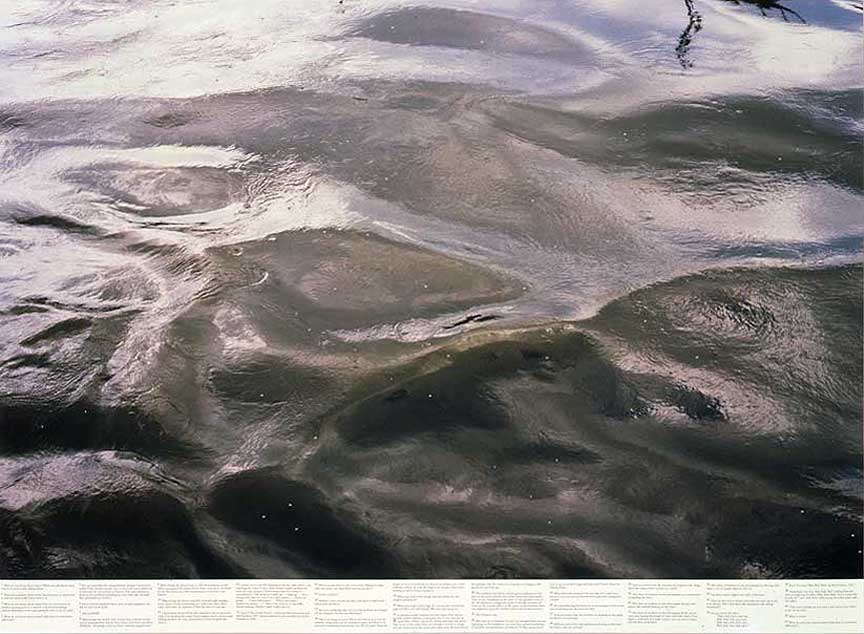
Still Water (The River Thames, for Example) – Image C, 1999. Offset lithograph (photograph and text combined) on uncoated paper; 30 1/2 × 41 1/2 inches. Edition of 7. Courtesy of Matthew Marks Gallery, New York.
Since Horn is such a prolific artist and doing justice to all of her work (which in addition to water, explores human identity, ecology, landscape, weather and language) would require no less than a book (several do exist), I’ll focus here on two of her pieces that represent her attempt to define water’s elusive nature: (1) Saying Water, a 40-minute monologue that she created about the Thames River in London; and (2) Vatnasafn / Library of Water, a project in Stykkisholmur, Iceland in which she restored a town library building as a public space housing her own installations and a place for community gatherings and programs.
Saying Water
Horn wrote Saying Water in 2012 while she was staying in A Room for London, a riverboat installation sitting on the roof of Queen Elizabeth Hall overlooking the South Bank of the river Thames. Her residency was part of a larger project entitled Hearts of Darkness, in which artists and “stowaways” from other professions were invited to create something new related to the river and the project’s theme.
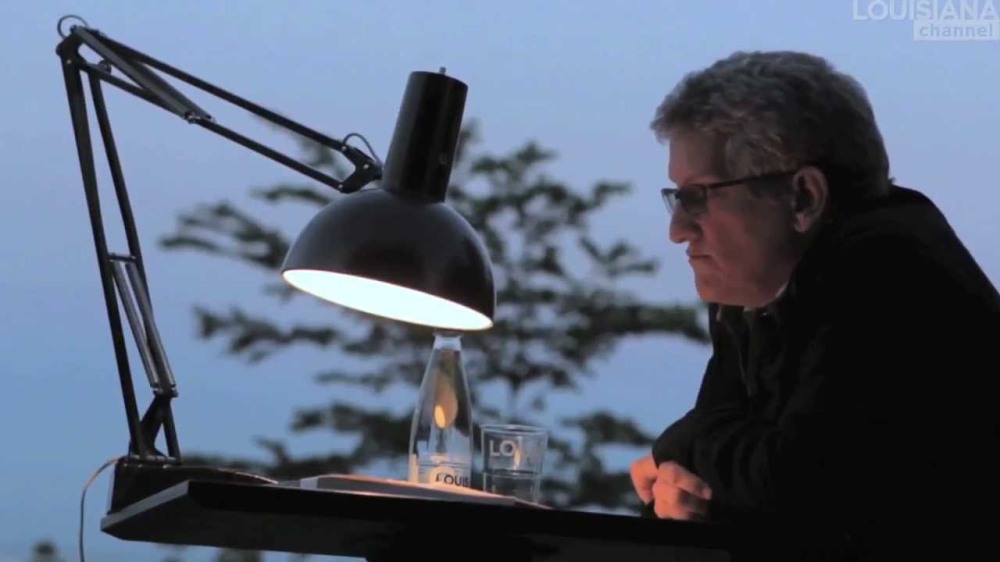
Roni Horn reading Saying Water at the Louisiana Museum of Art, Denmark in May 2012. Courtesy of Louisiana Channel.
As she reflects on the meaning of the dark, opaque and dirty Thames river, Horn incorporates song lyrics (“Blah, Blah, Blah” by George Gershwin; “Down by the River” by Neil Young; “Take Me to the River” by Al Green; etc.) and stories of suicide, sex and murder that occurred in or by the river. She poses numerous questions: “When you talk of the water, are you talking of yourself or the weather?” “Is water sexy?” “What does water look like?” “Do rivers really ever end?” But primarily, she is developing a comprehensive and powerful vocabulary about water itself and its physical, sensual, spiritual and fundamentally unknown qualities. Here is just a small sampling of her powerful visual language:
Water is… everywhere differently, a spiritual presence, an intimate experience, half the sky, an act of perpetual motion, familiar but elusive, troubled or calm, rough and disturbed, quiet, clear, still, cold or hot, brash or brisk, soft or hard, foul or fresh, limpid or languid, sweet, agitated, unsettled, deep, clean or filthy, a utopian substance, powerful, vulnerable, fragile, energetic, the future, a plural form, a master verb.
Water… reassures you, affirms you, shows you who you are, extends you out into the world, camouflages light, sighs, sucks, laughs, splishes, splashes, slashes, washes, murmurs, gushes, bubbles, babbles, shimmers, shines, gleams, twinkles, sparkles, blinks, winks, waves.
Black water… is always violent; it dominates; it’s alluring; it’s black milk; it’s life threatening; it’s mesmerizing.
Horn acknowledges the level of pollution in the Thames by imagining what the water contains: “not just the rats and sewage but the viruses and bacteria like hepatitis, dysentery, E. coli, biles and even a remnant of the plague… the polyphenols… the trichloral ethanes…” And at the end of the monologue, she proclaims that “when you look at water, you see what you think is your reflection but it’s not yours; YOU are a reflection of water.” Immerse yourself in Horn’s Saying Waterhere. Although listening once is great, twice or three times is better in order to absorb the full impact of her cadence and imagery.
Vatnasafn / Library of Water
Horn has a strong emotional tie to Iceland. Her first journey there was right after graduate school, when she traveled throughout the country by motorcycle. Since then she has returned again and again, ultimately establishing a residence in Iceland where she resides for part of the year, and incorporating its pristine landscape, changing weather, intense light and distinct geography as a major component of her work. In 2003, she began a long-term project to create a new identity and purpose for an existing library in the small town of Stykkisholmur, Iceland. Horn called it “the most beautifully situated library in the world,” overlooking the harbor and offering astounding views of the ocean and an overwhelming sense of sky, sea and weather.
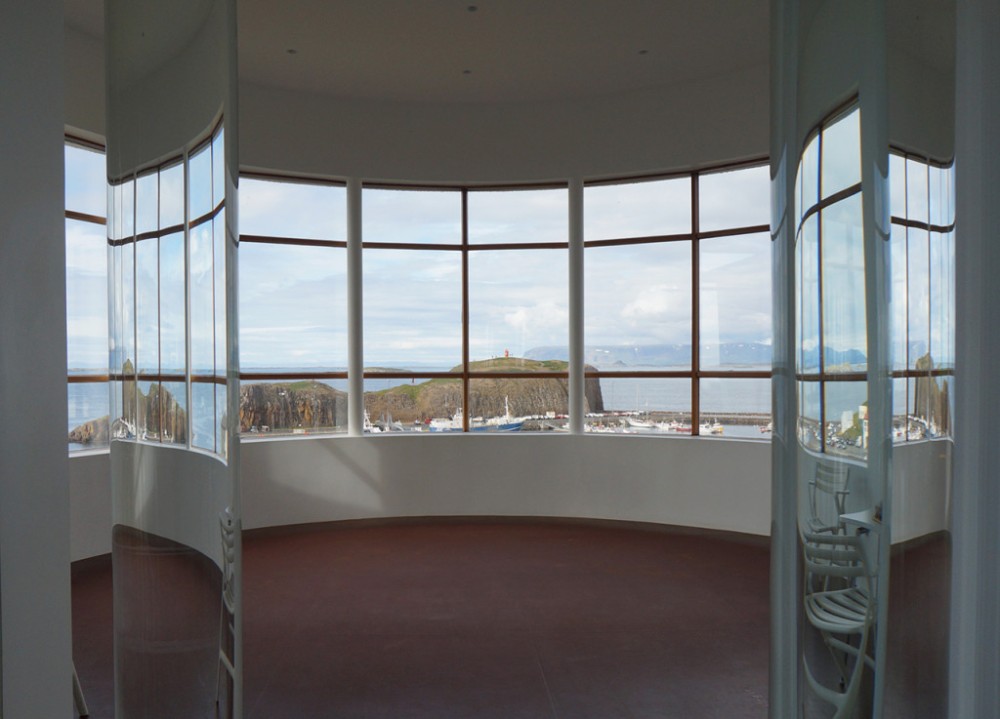
View of the water from Vatnasafn / Dictionary of Water, Stykkisholmur, Iceland.
Completed in 2007, the Library of Water contains three works by Horn: The first is a “bilingual sculpture installation,” a rubberized floor containing 100 inscribed words in Icelandic and English that refer to the weather, an integral part of life in Iceland. The second is a series of 24 floor-to-ceiling transparent columns filled with water from 24 of the major glaciers in Iceland that were formed millions of years ago and are receding at a rapid pace. The columns refract and reflect the light from the vast landscape outdoors, and create a sense of tranquility and peace within the interior space. The third work is a collection of stories on weather, a project that Horn undertook to record the memories of, and reflections on, weather from residents of the area in an attempt to capture its significance in their lives.
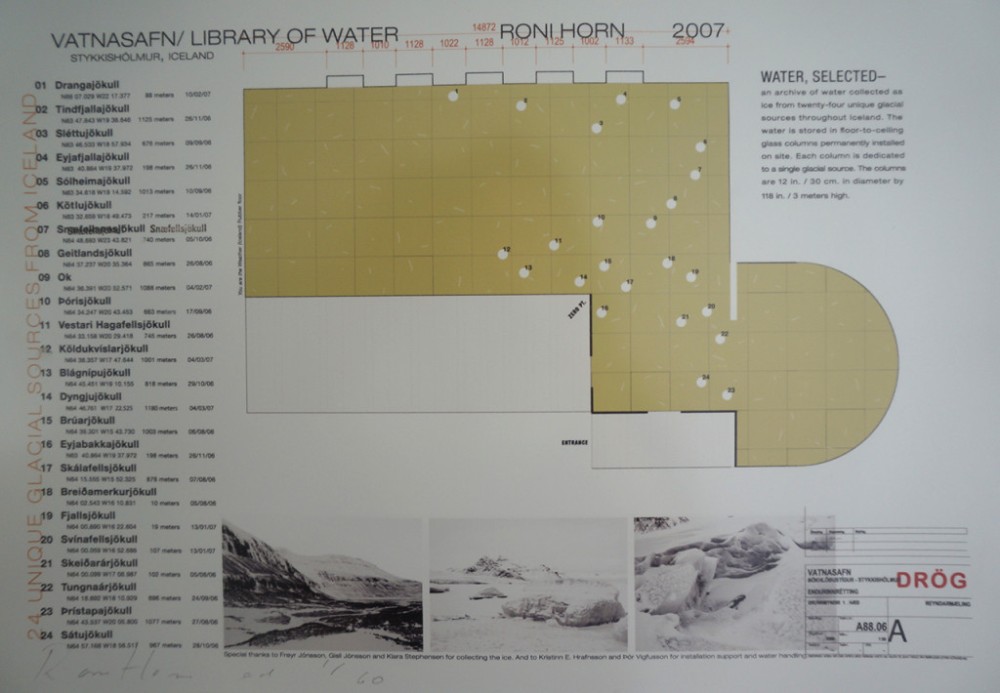
Documentation of the location of the sources of water and placement of columns for Installation of columns containing water from 24 glaciers in Iceland, Vatnasafn Dictionary of Water, Stykkisholmur, Iceland.
Horn has written, spoken and created hundreds of works of art about water of all kinds. In contemplating the dirty Thames, she marveled that
…even in its darkness, it has this picturesque element. It’s something about the human condition – not the water itself – humanity’s relationship to water. So, in the end, it doesn’t make a difference what the water looks like. It will always have this kind of picturesque quality to it because that’s almost a human need – that water be a positive force.
(Top image: Installation of columns containing water from 24 glaciers in Iceland, Vatnasafn Dictionary of Water, Stykkisholmur, Iceland.)
_____________________________
Susan Hoffman Fishman is a painter, public artist, writer, and educator whose work has been exhibited in numerous museums and galleries throughout the U.S. Susan’s latest bodies of work focus on the threat of rising tides caused by climate change, the trillions of pieces of plastic in our oceans and the wars that are predicted to occur in the future over access to clean water. Susan is also the co-creator of two interactive public art projects: The Wave, which addresses our mutual need for and interdependence on water and Home, which calls attention to homelessness and the lack of affordable housing in our cities and towns.
Ebru, a decorative paper art, hails from East and Central Asia in the 10th and 16th centuries, respectively. The technique involves sprinkling and brushing pigments onto the surface of oily water in a pan, then laying paper atop the water, effectively dyeing the paper with tendrils of color. Ay is classically trained in the art form, and his loose, paisley-like patterns beautifully mimic the Dutch post-Impressionist’s celestial swirls. His process is animated in the most mesmerizing video the van Gogh fanboy cult has yet produced. To reveal the extent of his ebru chops, Ay also creates a striking marbled portrait of van Gogh himself.
Garip Ay, clip from “Van Gogh on Dark Water Animation” (2016)
Garip Ay, clip from “Van Gogh on Dark Water Animation” (2016)
Today is the 19th annual World Water Day and French nonprofit Solidarités International marks the occasion with a beautiful short film to raise awareness about safe drinking water: It’s estimated that 3.6 million people, of which 1.5 million are children under 5, die of diseases caused by water contamination every year, making it the world’s leading cause of death. Yet both the public and political leaders remain largely unaware and thus unlikely to take action against this preventable epidemic.
This film, produced by agency BDDP Unlimited and directed by young director, illustrator, musician and photographer Clément Beauvais, is both a moving reminder about the importance of this fundamental substance and a specific call to action for journalists to spread awareness about it and appeal to readers to sign a petition that will be personally handed to the French president during the 6th World Water Forum in March 2012.
Looking for meaningful ways to support World Water Day beyond awareness? Here are afew actionable ideas. And to further grasp both the beauty and the gravity of the subject, don’t miss the remarkable Blue Planet Run.
From walls to paper, or what the eye of the octopus has to do with swans and women’s role in the arts.
I’ve been a longtime fan of independent Indian publisher Tara Books, who for the past 16 years has been giving voice to marginalized art and literature through a commune of artists, writers, and designers collaborating on remarkable handmade books, including I Like Cats, Do!, and Tara’s crown jewel, The Night Life of Trees. But now comes what’s positively the most exquisite book I’ve ever held in my hands: Waterlife by artist Rambharos Jha, who explores the marine wonderland through vibrant Mithila art, a form of folk painting from Bihar in eastern India.
'The Lobster's Secret'
'Crocodile Smile'
'Snake Festival'
Jha writes:
I was born in the culture-rich district of Darbanga, in the Mithila region. But my father moved along with all of us to Madhubani, where he started work in a government-supported art and cultural project. This project sought to breathe new life into local art traditions and also to help artists earn a living. Since women had traditionally decorated walls and courtyards, they participated in this project in large numbers…
Living as we did in Madhubani, I had a chance to look at what they were painting. I would spend hours watching them work. I had not known of this art earlier and wondered why I was drawn to it, and what purpose there could be in my being attracted to these lines and shapes? Mixing colours and ideas, the women drew pictures that took hold of my mind.
Jha eventually learned to draw himself, initially drawing on stories from Hindu mythology and eventually moving on to more secular subjects, pursuing his own creative impulse but remaining deeply inspired by tradition.
Mithila art was originally painted on the walls of houses during festival season, but in the late 1970s, it migrated from walls to paper.
The book comes in a limited edition of 3,000 hand-numbered copies and, like all handmade Tara gems, is screen-printed by local artisans in Chennai using traditional Indian dyes, whose earthy scent you can smell as you leaf through the thick, textured pages.
Waterlife was among 10 books I curated for the TED 2012 Bookstore and is, without a shadow of exaggeration, the most beautiful book I’ve ever laid eyes on. The screen does it no justice whatsoever.
Este surrealista gallego (que no gallego surrealista) nació en A Coruña (ciudad a la que él llamaba Percalinópolis) en 1908. Era hijo de Manuel Lugrís, uno de los fundadores de la Real Academia Galega y futuro presidente de la misma; y de Purificación González, pianista. Así Urbano Lugrís vivió en un ambiente cultural importante en la Galicia de comienzos del S. XX.
Comenzó a estudiar para ser perito mercantil, pero abandona los estudios para irse a Madrid en 1930, donde se empapa del ambiente vanguardista de la capital. Allí conoce a Rafael Dieste, Federico García Lorca y Rafael Alberti, entre otros. De esa época es su trabajo en el grupo teatral La Barraca, diseñando figurines y decorados.
Se casó con Paula Vadillo, con la que tuvo dos hijos Urbano (también pintor) y Paula (para que la saga perdurase).
Urbano Lugrís
En 1954 fundó la revista Atlántida con sus amigos Mariano Tudela y Jose Mª de Labra, donde escribía artículos, poesías y realizaba las ilustraciones y la portada. Simultáneamente desarrollaba su labor pictórica, basada fundamentalmente en cuadros y murales. Fue un pintor autodidacta, de predilección por los temas relacionados con el mar, como muestran los ejemplos que aquí pongo.
Onde iría? (1944) Fundación Caixa Galicia
Recordando mejores tiempos (1944) Fundación Caixa Galicia
Sus cuadros son de pequeño formato, siempre con la presencia del mar, entrecruzada con lo mítico y lo onírico. Es un pictor de un estilo inconfundible, con reminiscencias de los surrealistas, como Salvador Dalí y René Magritte. También se nota la influencia de los llamados metafísicos, como Giorgio de Chirico y Carlo Carrà.
Mar de los sargazos (1946) Fundación Caixa Galicia
Su obra está plagada de personajes tradicionales de los mitos y leyendas del mar, como en su Sirena alada (1946), pintada con los colores azulados y oscuros característicos del pintor. La figura está enmarcada en un ambiente de ruinas, como le gustaba al autor.
Sirena alada (1946) Fundación Caixa Galicia
En Templo Sumergido (1946), evoca lo mítico de las ciudades perdidas, sumergidas en las profundidades abisales, como la propia Atlántida (que también era el nombre de la revista que cofundó). Restos de un mundo pasado, naufragios incluídos, cohabitan con bancos de peces, medusas, erizos de mar y caracolas. El surrealismo de Lugrís es mucho más "amable" que el de los otros antes citados, más dueños de un mundo más loco y erótico que nuestro protagonista. Su mundo era mucho más naïf.
Templo sumergido (1946) Fundación Caixa Galicia
Este personaje era asiduo de bares y tabernas y regalaba cuadros a cambio de un vaso de vino o de una cunca de caldo. Así hoy quedan multitud de murales fruto de su paso por bares de Coruña y Vigo: el Caffé Vecchio, La Bottega, A Mundiña o el bar Nova Galicia de Santiago, todos ellos en Coruña. También los murales de la iglesia de Vilaboa (al lado de Coruña), son obra suya.
Dibujaba a todas horas. Se decía que un día un amigo suyo tardó en abrirle, y mientras esperaba en el portal, sacó un lápiz y empezó a dibujar en la pared. Algo así les ocurrió a dos cuadros que pintó en una pared de un piso de la calle San Andrés en Coruña, para decorar la tienda de alfombras de un amigo, y que fueron "rescatados" por un anticuario coruñés. El traspasar de las paredes de ladrillo y hormigón al lienzo fue un trabajo costoso, que se hizo pegando papel japonés a las paredes y luego transfiriéndolo al lienzo. Ahora están a la venta en el anticuario:
Cuadros de Lugrís "rescatados" de una pared y ahora a la venta
En 1961 murió su mujer y cuatro años más tarde se traslada a Vigo (Xouba City, como él decía), en medio de una gran depresión.
Murió en 1973 en Vigo, en la víspera de Nochebuena.
The video depicts the revolutionary nature of the life cycle of a droplet of water and it's cyclical journey. The project was a three-fold collaboration between myself, Helen Friel and Jess Deacon. From the original idea, through the creative development and process, our individual skill sets enabled the project to spring to life.




 Today is the 19th annual


